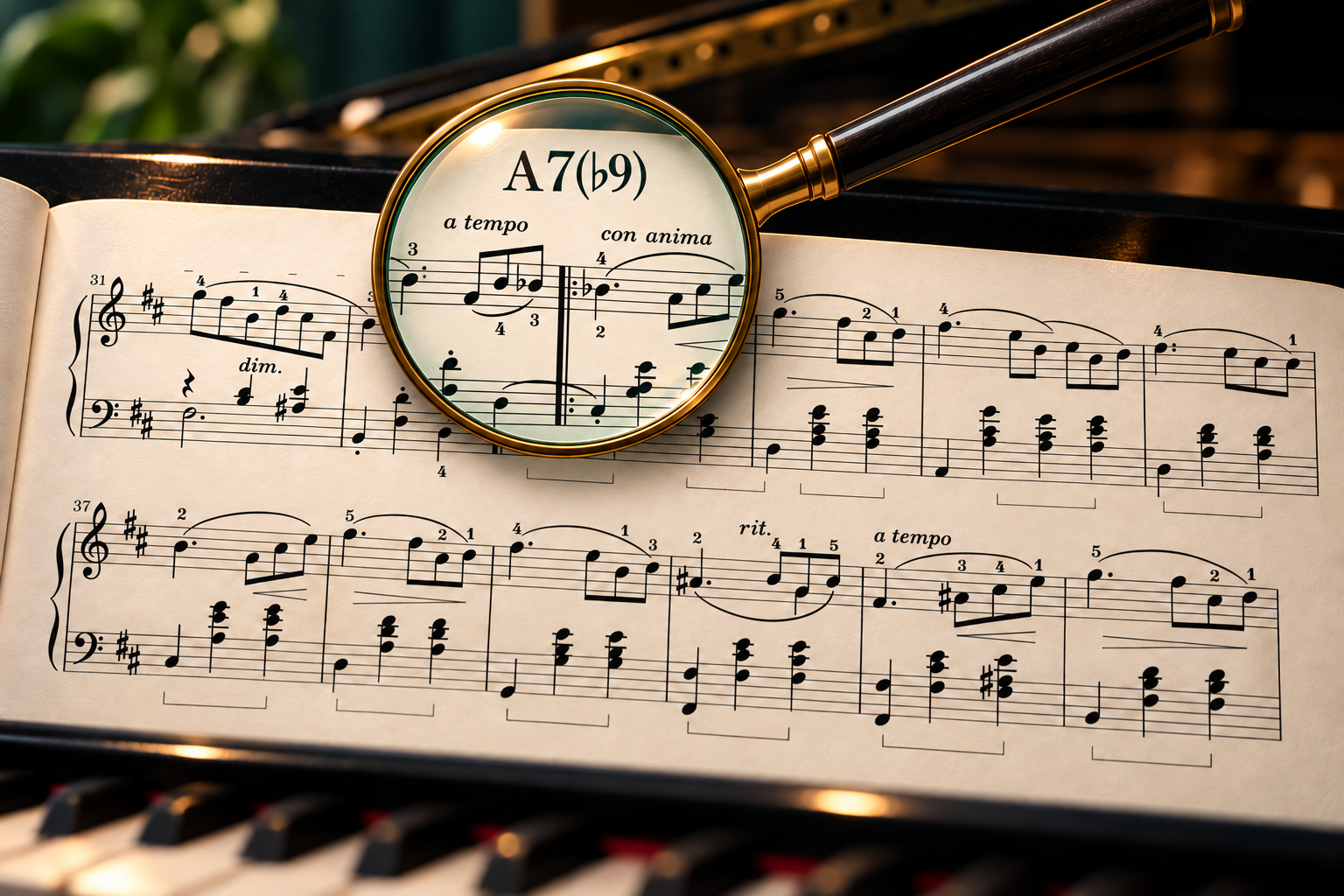
Classical scores do not normally use chord symbols. If one appears above the stave in an edition of Chopin, it was almost certainly added later by an editor rather than written by Chopin himself.
If your musical background is mainly classical, symbols such as Cmaj7, C9 or G7(♭9) can look as though they belong to a different musical world. Yet the sounds they describe may already be present in music you play. What is unfamiliar is often the shorthand, rather than the harmony itself.
When we play from a classical score, the notes are written out in full. They may be divided between the hands, inverted, repeated, decorated or woven into a melody. A chord symbol sets much of that detail aside and gives us a compact description of the notes beneath it.
In this article, I want to explore why adding this shorthand to the way we think about the notes on the page can be particularly helpful, even though the symbols themselves are absent from the original score.
A chord symbol is shorthand for a sound
The letters, numbers and signs in a chord name can initially make it look more complicated than the notes it describes. But if we turn the idea around, a longer chord name is simply a convenient way to remember a surprising amount of information with very little effort.
As we saw in Mastering chords for classical pianists, a plain C asks us to begin with a C major chord: C, E and G. Cmaj7 keeps those three notes and adds B, the major seventh above C. C7 looks similar on the page, but the seventh is now B flat. The small difference between maj7 and 7 changes one note and gives us a noticeably different sound.
The same principle applies as chord names become longer. A few common conventions show how much information the shorthand can hold:
- C9 starts with a C7 chord and adds the ninth, whereas Cadd9 adds the ninth without the seventh.
- When a flat or sharp is attached to an extension, as in ♭5 or ♭9, it changes that named interval.
- Diminished (°), augmented (+) and suspended (sus) alter the construction of the basic chord in other ways.
We do not need to memorise every possible symbol before we begin. Once we understand the shorthand, we can compress an awful lot of notes into a simple pattern.
The keyboard gives us an immediate way to make sense of this. We can build the chord, play it and hear it. The symbol then becomes attached to something we can actually hear and feel under our hands.
The symbol is not a genre label
Chord symbols are the usual convention in lead sheets and in jazz or popular-music teaching. They are almost never printed in a classical score. It is understandable, then, that a classical pianist might see A7(♭9) or A7(9) and assume that the harmony itself belongs elsewhere.
However, the symbol and the sound are two different things. Chopin did not use chord symbols above the stave, but that does not mean he did not use extended or altered harmony. The notes create the colour. A modern chord symbol simply gives us a concise way to name it and try it for ourselves.
One place where we can hear this is Chopin’s Waltz in B minor, Op. 69 No. 2. In measures 32 and 33, the harmony can be written as A7(♭9). The ninth above A is B natural, but Chopin uses B♭, which gives us the flattened ninth. In measure 37, the corresponding note is B natural, giving us A7(9).
Something particularly interesting happens in measures 40 and 41. Chopin writes A♯, the same physical key on the piano as B♭, but the note now has a different job. As the music leaves its temporary home in D major, the A♯ forms part of F♯7 and points us back towards the original key of B minor.

The point is not to relabel every bar of Chopin. It is to show that apparently unfamiliar terminology can describe sounds which classical pianists may already have heard and played many times. It can also help us see what the music is doing and where it is going, giving us additional mental hooks when we read or memorise it.
What the chord is doing matters more than its name
A chord symbol describes the chord’s essential construction, but it does not prescribe every voicing, omission or doubled note. We can see that Chopin does not write these chords as neat stacks of notes.
Nor does the symbol tell us why the chord is there. For that, we need to look at the relationship between one musical event and the next.
By measure 31, the waltz has effectively reached D major. When A♯ appears in measures 40 and 41, we can see the dominant of B minor taking shape: in chord-symbol terms, F♯7. This gives us a strong clue that the music is heading back to B minor.
Context still matters. The A7(♭9) and A7(9) belong to the passage in D major, while the later A♯ has a different harmonic purpose. Recognising the chord names and the different spellings helps us see both where we are and where the music is going.
A clearer place to hear what is happening
A classical score presents many things at the same time: melody, rhythm, spacing between the hands, decoration and the harmonic relationship underneath. All of them belong to the music, but they can make both an individual chord and its relationship to the next harder to see and hear when we are trying to isolate them for the first time.
This is why I have always enjoyed using lead sheets as a kind of harmonic laboratory. We can play the chord, change one note and listen to what happens next without having to process the rest of the score at the same time. Once we know the sound in that clearer setting, we can return to the full score and notice the same behaviour when the notes are spread between the hands, inverted or decorated.
The lead sheet is simply a less crowded place to become familiar with the sound. We can then bring that understanding back to the classical music in which the harmony has its full context.
Building from chord recognition
If identifying ordinary major, minor and seventh chords still takes some effort, you can begin with my earlier article Mastering chords for classical pianists. The follow-on article Converting dots into chords quickly and easily then looks at recognising chords inside written notation.
These skills provide a useful addition to our musical toolkit. The labels become more useful when they help us notice a relationship: tension leading to release, one key area giving way to another, or an unfamiliar accidental gaining a clear musical purpose.
Complex-looking chord symbols need not become a catalogue to memorise. They give us a practical way to separate out sounds that already belong to the wider harmonic language. Once we can hear and recognise those sounds, we are in a better position to ask what they are doing in the music itself.
Going beyond the chord name
If you would like to take this way of thinking further, I develop it step by step in Understanding Harmony for Pianists. We begin at the keyboard, where the relationships are easier to hear, and then look for the same behaviour inside classical repertoire.

