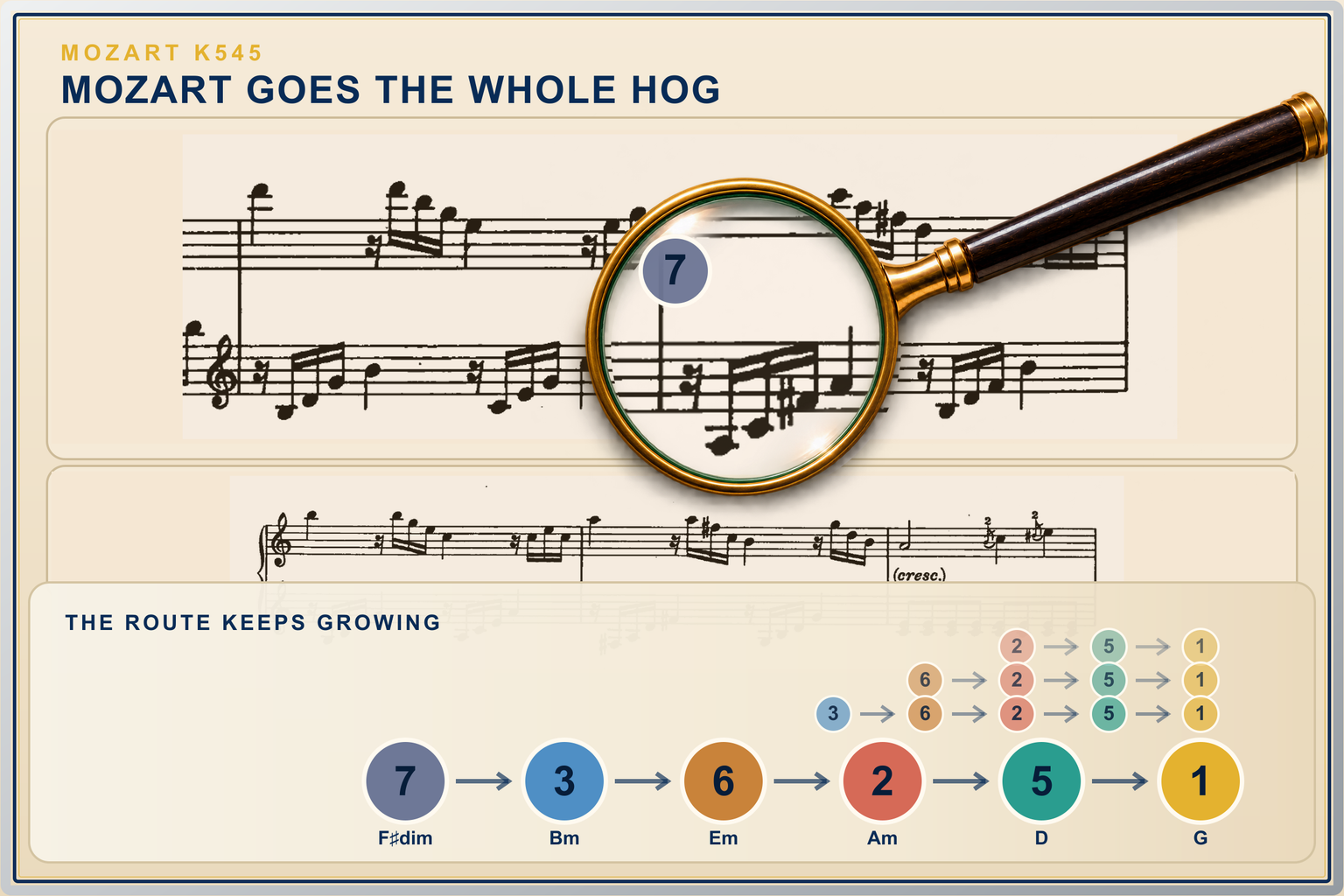
You have probably come across the idea of a two-five-one progression. You may even have heard of a six-two-five-one. But what if I told you that Mozart goes the whole hog and gives us a complete seven-three-six-two-five-one progression in the first movement of his Sonata Facile? In fact, he gives us the same progression twice, in two different keys.
At first, that might sound like an interesting piece of analysis rather than something of practical use to us as pianists. However, the value is not in remembering an impressive-looking sequence of numbers. It is in discovering that a passage which appears to contain many separate notes and chords is actually following a connected route. Once we know what to look for, that route gives us another way to organise what we see, hear and play.
This is one of the ideas I explore in Understanding Harmony for Pianists. The aim is not simply to give names or numbers to chords, but to build a practical framework that helps us recognise how the music in front of us is organised. Mozart’s K545 gives us a particularly interesting Case Study of how that can work.
A familiar sonata with a surprisingly mobile harmony
I say interesting because, whilst the first movement begins in C major, ends in C major and carries no sharps or flats in its printed key signature, this is not the full story. If we looked only at the beginning and the end, it would be tempting to think that C major tells us everything we need to know about where the music is.
Yet the harmony does not remain in C major throughout. Mozart takes us first to G major, then through G minor, D minor and F major before returning through G major and finally arriving home in C. He does all of this without replacing the key signature.
This gives us our first useful question: where are we? Before trying to account for every note, we can look for the places where Mozart makes an arrival especially clear. At measure 12, for example, he states a G-major chord emphatically across several octaves. Later, tonic-dominant-tonic movements establish G minor, D minor and F major with similar clarity.
The accidentals then become more than individual notes to remember. F-sharp helps turn D minor into D7 on the way to G. C-sharp helps create A7 before the arrival in D minor. B-flat belongs naturally to F major and participates in the route towards that destination. You might also notice that the 5th note of G major is D, the 5th of D minor is A and the 5th of F is C. This is no coincidence. The altered notes help us understand both where the music is going and why particular chords appear.
Watch Video 1: Sonata Facile Is in C Major – We All Know That. Well, Actually…
Why should we care where the music has arrived?
Identifying G major would be of limited value if it gave us nothing more than an analytical label. In practice, however, it changes what we can reasonably expect to find next.
From measure 14, the continuing F-sharps support the idea that the music is now being built from the notes of the G-major scale. If we build a simple three-note chord on each note of that scale, we obtain the G-major Chord Family: G major, A minor, B minor, C major, D major, E minor and F-sharp diminished.
A Chord Family does not tell us that Mozart must use every one of those chords, nor that nothing else can appear. It does, however, give us a sensible working expectation. Even more importantly, this pattern of chord qualities is the same across every major key.
This becomes particularly useful in the arpeggiated passage from measures 18 to 21. What can initially look like a succession of fresh patterns turns out to use every member of the G-major Chord Family. From F-sharp diminished onwards, the roots follow a regular path: F-sharp, B, E, A, D and finally G.
We still need to read the notes, choose suitable fingering and practise the passage. But the notes now sit on a harmonic map. The key gives us expectations about the likely notes and chord qualities, whilst the movement between the roots gives the passage direction. Again, this idea of 5 notes away links each chord to its predecessor.
Watch Video 2: Why Should We Care That a Piece in C Seems Suddenly to Be in G Major?
The chord names change but the relationship remains
Mozart gives us another particularly clear comparison when he restates the opening theme in F major from measure 42. The original begins with C, G7, C and F. The later version begins with F, C7, F and B-flat. Every chord name has changed, yet the relationship between the chords is the same.
If we number each chord according to its place in the current key, both statements follow the same map: one-five-one-four, one-five-one-four, one-two-five-one. The numbers do not replace the chord names or the sound. They give us a compact way to describe a relationship which survives when the theme moves into another key.
This is one reason numerical thinking can be so useful. If we remember only the chord names, C major and F major can appear to require two separate sets of information. If we also recognise the underlying relationships, the second passage reinforces something we have already understood in the first.
Watch Video 3: The Chord Names Change – So How Can the Pattern Stay the Same?
Mozart goes the whole hog: the 7-3-6-2-5-1 progression
We can now return to the longer progression from the beginning of this article. In G major, measures 18 to 21 take us through F-sharp diminished, B minor, E minor, A minor, D major and G major. When we number those chords within the key, we get seven-three-six-two-five-one.
After the music has returned to C major, Mozart gives us the same route again in measures 59 to 66: B diminished, E minor, A minor, D minor, G major and C major. The chord names have changed, but the numbered progression is again seven-three-six-two-five-one.
The chain contains relationships we may already recognise. Five moves to one. Two-five-one extends the approach. Six-two-five-one begins one stage earlier. Mozart simply continues the pattern until the diminished chord on the seventh degree begins the whole route.
This does not mean that Mozart was composing from a chart of numbers. The numbers are our shorthand for relationships that we can hear and see in the music. Their value is that they expose the same direction beneath two passages which otherwise use different notes and chord names.
What this gives us at the piano
The point of this Case Study is not that we should label every chord before playing a piece. It is that harmony can give us another layer of useful information. We can identify strong destinations, use accidentals as clues, form expectations from the current key and recognise a familiar relationship when it appears in a new setting.
Those landmarks can support reading, learning and remembering because the notes no longer need to exist only as isolated details. They become part of a route. The physical work of playing and practising remains, but we have more ways to understand what that work is building.
If you would like to explore the examples at the piano, each of the three videos explores them in more detail. The first follows Mozart’s changing harmonic locations, the second asks what knowing the key allows us to expect, and the third shows how numbers preserve the same relationships when the key changes.
Going beyond K545
K545 gives us an unusually transparent Case Study, but the underlying ideas are not confined to this Sonata. Composers continually create direction, expectation and arrival through relationships between chords, even when those relationships are less exposed on the page.
Understanding Harmony for Pianists develops this into a broader practical framework. We begin at the keyboard, where the behaviour is easier to hear and see, and then recognise the same relationships inside fuller classical textures. If this way of looking at Mozart has made you curious about what harmony might reveal in other music, you can take a closer look at the course on the Course Page.


